Campaign
C1 — the epitope triage on the apical domain
2026-10-25
96 Genie 3 and 121 hosted RFD4-Proteina designs across four apical patches. The standard co-fold screen is blind on this target — proven with controls — so a directed restrained read decided: the conserved dual-anchor patch advances, one design short for the organizers' tip.
basis: 4 experiments, 48 designs recorded, best ipSAE 0.185
01 / Goal
Choose the epitope for the binder build with a pre-registered rule, on a screen validated with controls.
2026-10-25 · 4 experiments · 48 designs · tools: Genie 3, ProteinMPNN, RFD4-Proteina, Boltz-2, IPSAE, Chai-1
- Strategy difference: the only campaign whose deliverable is a decision, not designs - it judges epitopes (four apical patches, two generator arms) and every later campaign inherits that choice. The others each vary one axis of the work; C1 picks the ground they are built on.
- Answers: which of the four apical patches produces dockable interfaces?
- Answers: can any co-fold screen be trusted on this target?
02 / Experiments
Each experiment: the method, the tools, the steps — and its proteins, folded. The climb first.
The best score each phase reached — the campaign's climb. human / mouse = best ipSAE at the designed interface (of 5 samples); switch = pH linkage, positive = tighter at 7.4.
| phase | human | mouse | designs |
|---|---|---|---|
| G — four patches, two generators | 0.752 | 0.522 | 48 |
01 · G — four patches, two generators 2026-10-23
tools Genie 3ProteinMPNNRFD4-Proteina
96 local Genie 3 backbones (CA-only MPNN sequences) and 121 hosted RFD4-Proteina designs spanning the organizers' tip, two conserved patches and a conserved dual-anchor pair.
- 01 · Generate against four hotspot sets
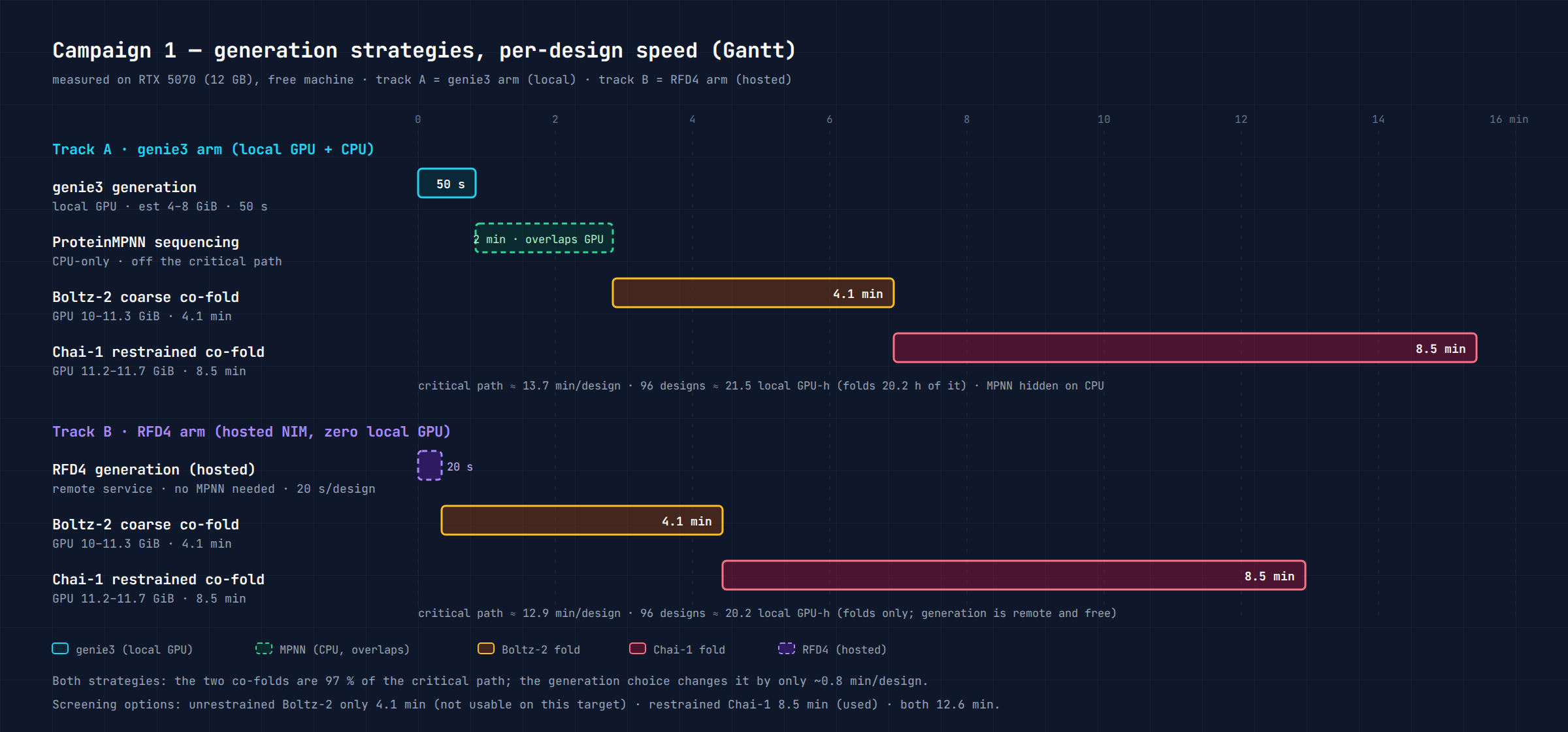
- 02 · Screen geometry before folding (all 220 pass)
- 03 · Sequence the local arm with ProteinMPNN
Outcome. 220 designs, all on-patch by construction.
Proteins · 48 designs · 48 scored
| design | score | human | mouse | sites (h/m) | ipsae_min | pDockQ2 | ipTM | sequence |
|---|---|---|---|---|---|---|---|---|
e12_18 | 51.7 / 100 | 0.752 | 0.336 | — / — | 0.012 | 0.035 | 0.752 | seq |
e12_9 | 51.7 / 100 | 0.655 | 0.455 | — / — | 0.131 | 0.082 | 0.655 | seq |
e12_6 | 46.7 / 100 | 0.639 | 0.340 | — / — | 0.011 | 0.048 | 0.639 | seq |
e12_15 | 41.7 / 100 | 0.579 | 0.275 | — / — | 0.149 | 0.096 | 0.579 | seq |
e12_7 | 43.3 / 100 | 0.563 | 0.290 | — / — | 0.161 | 0.113 | 0.563 | seq |
e12_5 | 38.3 / 100 | 0.552 | 0.233 | — / — | 0.000 | 0.019 | 0.552 | seq |
e12_12 | 40.0 / 100 | 0.531 | 0.522 | — / — | 0.185 | 0.105 | 0.531 | seq |
e12_21 | 36.7 / 100 | 0.460 | — | — / — | — | — | 0.460 | seq |
e12_19 | 31.7 / 100 | 0.441 | — | — / — | — | — | 0.441 | seq |
e12_20 | 31.7 / 100 | 0.361 | — | — / — | — | — | 0.361 | seq |
e12_22 | 33.3 / 100 | 0.341 | — | — / — | — | — | 0.341 | seq |
e12_4 | 30.0 / 100 | 0.338 | — | — / — | — | — | 0.338 | seq |
e12_14 | 31.7 / 100 | 0.311 | — | — / — | — | — | 0.311 | seq |
e12_3 | 31.7 / 100 | 0.305 | — | — / — | — | — | 0.305 | seq |
e12_1 | 30.0 / 100 | 0.301 | — | — / — | — | — | 0.301 | seq |
e12_17 | 31.7 / 100 | 0.300 | — | — / — | — | — | 0.300 | seq |
e12_8 | 28.3 / 100 | 0.298 | — | — / — | — | — | 0.298 | seq |
e12_0 | 30.0 / 100 | 0.296 | — | — / — | — | — | 0.296 | seq |
e12_11 | 31.7 / 100 | 0.272 | — | — / — | — | — | 0.272 | seq |
e12_16 | 30.0 / 100 | 0.268 | — | — / — | — | — | 0.268 | seq |
e12_2 | 31.7 / 100 | 0.264 | — | — / — | — | — | 0.264 | seq |
e12_10 | 28.3 / 100 | 0.237 | — | — / — | — | — | 0.237 | seq |
e12_13 | 28.3 / 100 | 0.224 | — | — / — | — | — | 0.224 | seq |
e12_23 | 28.3 / 100 | 0.211 | — | — / — | — | — | 0.211 | seq |
e0_22 | 43.3 / 100 | 0.556 | 0.466 | — / — | 0.011 | 0.032 | 0.556 | seq |
e0_21 | 41.7 / 100 | 0.543 | 0.284 | — / — | 0.053 | 0.106 | 0.543 | seq |
e0_19 | 41.7 / 100 | 0.520 | 0.360 | — / — | 0.012 | 0.042 | 0.520 | seq |
e0_10 | 43.3 / 100 | 0.506 | 0.344 | — / — | 0.011 | 0.030 | 0.506 | seq |
e0_13 | 36.7 / 100 | 0.468 | 0.268 | — / — | 0.000 | 0.018 | 0.468 | seq |
e0_2 | 31.7 / 100 | 0.437 | — | — / — | — | — | 0.437 | seq |
e0_5 | 31.7 / 100 | 0.428 | — | — / — | — | — | 0.428 | seq |
e0_7 | 31.7 / 100 | 0.428 | — | — / — | — | — | 0.428 | seq |
e0_11 | 31.7 / 100 | 0.407 | — | — / — | — | — | 0.407 | seq |
e0_18 | 31.7 / 100 | 0.400 | — | — / — | — | — | 0.400 | seq |
e0_16 | 31.7 / 100 | 0.393 | — | — / — | — | — | 0.393 | seq |
e0_6 | 28.3 / 100 | 0.388 | — | — / — | — | — | 0.388 | seq |
e0_14 | 31.7 / 100 | 0.387 | — | — / — | — | — | 0.387 | seq |
e0_3 | 30.0 / 100 | 0.320 | — | — / — | — | — | 0.320 | seq |
e0_17 | 31.7 / 100 | 0.301 | — | — / — | — | — | 0.301 | seq |
e0_20 | 33.3 / 100 | 0.299 | — | — / — | — | — | 0.299 | seq |
e0_12 | 30.0 / 100 | 0.299 | — | — / — | — | — | 0.299 | seq |
e0_0 | 33.3 / 100 | 0.291 | — | — / — | — | — | 0.291 | seq |
e0_15 | 30.0 / 100 | 0.278 | — | — / — | — | — | 0.278 | seq |
e0_9 | 28.3 / 100 | 0.277 | — | — / — | — | — | 0.277 | seq |
e0_8 | 30.0 / 100 | 0.270 | — | — / — | — | — | 0.270 | seq |
e0_4 | 28.3 / 100 | 0.269 | — | — / — | — | — | 0.269 | seq |
e0_23 | 28.3 / 100 | 0.240 | — | — / — | — | — | 0.240 | seq |
e0_1 | 28.3 / 100 | 0.207 | — | — / — | — | — | 0.207 | seq |
What the columns mean:
- ipSAE min — The weaker of the two interface directions. The best single lab-binding predictor in the 2025 meta-analysis. (higher is better)
- pDockQ2 — Interface quality that counts only the interface residues. The second half of the acceptance bar (>= 0.23). (higher is better)
- ipTM — Predicted interface TM. Stays high even when the interface score collapses — never decide on ipTM alone. (higher is better)
02 · V — the blind screen, proven with controls 2026-10-24
tools Boltz-2IPSAE
495 co-fold samples were read against the designed patches before anything was believed: the known-good control reproduces, and the native virus binder refuses to dock.
- 01 · Fold the challenge-2 champion control — reproduces at ipSAE 0.84-0.90
- 02 · Fold the native B19 RBD — floats 42-55 A away, ipSAE 0.000
- 03 · Re-check the footprint straight from the experimental structure (auth 202-212 + 348/371)
Outcome. The unrestrained read is fold-limited on this target: recorded as cannot-decide, not as an epitope verdict.
03 · R — the directed re-read 2026-10-24
tools Chai-1
With the interface directed by pocket restraints, the same models dock designs at their designed patch and rank them — the first read that discriminates.
- 01 · Calibrate on the native complex: directed ipTM 0.42-0.48
- 02 · Screen 48 triage designs (five samples each, stable within +-0.02)
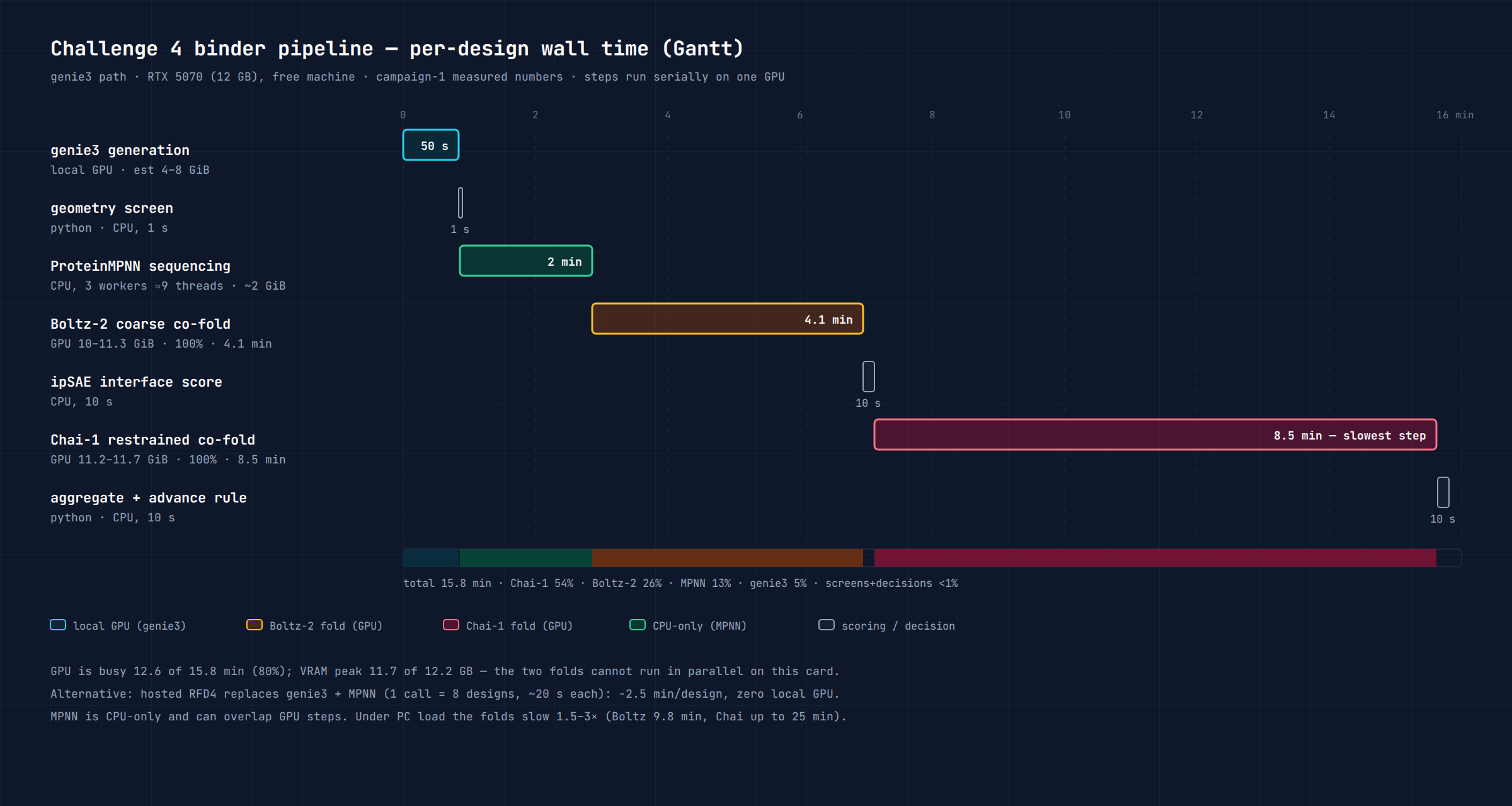
- 03 · Falsify the restraint-count confound (equal-bars rerun, no jump)
Outcome. A rankable, directed consistency read; caveat recorded: directed, not independent binding evidence.
04 · D — the decision 2026-10-25
The registered rule (25 percent of a set at or above 0.45, level with the native reference) applied to the full data, guards on.
- 01 · Score all 48 triage designs
- 02 · Apply the guarded rule: the conserved dual-anchor patch advances
- 03 · Settle the margin with a second seed: the tip stays one short
Outcome. Binder build runs on the conserved dual-anchor patch; the tip is carried as a secondary, not eliminated.
03 / Results — this campaign's best designs
1 of this campaign's designs are in the submission set (1 of the top 12 shown). The ranked submission set and its 3D explorer are in the submission section of the challenge page.
| design | score | human read | mouse read | ipSAE | pDockQ2 | in submission |
|---|---|---|---|---|---|---|
e12_18 | 51.7 / 100 | 0.752 | 0.336 | 0.0117 | 0.0353 | |
e12_9 | 51.7 / 100 | 0.655 | 0.455 | 0.1311 | 0.0821 | ✓ |
e12_6 | 46.7 / 100 | 0.639 | 0.34 | 0.0114 | 0.0481 | |
e12_15 | 41.7 / 100 | 0.579 | 0.275 | 0.1494 | 0.0956 | |
e12_7 | 43.3 / 100 | 0.563 | 0.29 | 0.1614 | 0.1132 | |
e0_22 | 43.3 / 100 | 0.556 | 0.466 | 0.0107 | 0.0319 | |
e12_5 | 38.3 / 100 | 0.552 | 0.233 | 0.0 | 0.0186 | |
e0_21 | 41.7 / 100 | 0.543 | 0.284 | 0.0532 | 0.106 | |
e12_12 | 40.0 / 100 | 0.531 | 0.522 | 0.1855 | 0.1053 | |
e0_19 | 41.7 / 100 | 0.52 | 0.36 | 0.0121 | 0.0421 | |
e0_10 | 43.3 / 100 | 0.506 | 0.344 | 0.0107 | 0.0303 | |
e0_13 | 36.7 / 100 | 0.468 | 0.268 | 0.0 | 0.0179 |
What the columns mean:
- ipSAE min — The weaker of the two interface directions. The best single lab-binding predictor in the 2025 meta-analysis. (higher is better)
- pDockQ2 — Interface quality that counts only the interface residues. The second half of the acceptance bar (>= 0.23). (higher is better)
- selection score (0-100) — The primary selection score, from select-top20.py: 100 x (2.0*A + 1.5*B + 1.0*E + 0.5*R) / 25. A = activation geometry (how many of the 6 agonist features the pose meets, and whether samples agree), B = binding (ipSAE, with a bonus for pDockQ2 >= 0.30), E = expression (pLDDT band + Kyte-Doolittle hydropathy), R = epitope reach. Each component is capped at 5, so the weighted total caps at 25. The six epitope-gate additions of 2026-11-04 carry the v4 composite instead (25 i_pDAE + 15 ipTM + 15 dfree + 15 E + 10 dWT + 20 peptide_read): same 0-100 scale, different formula. Row order is this score, descending. (higher is better)
04 / Binding
The designs of this experiment on Human transferrin receptor 1 ectodomain homodimer (UniProt P02786, residues 121-760) and mouse TfR1 (123-763)., in the structure explorer. The eye icon on the left toolbar opens the design list (one or many, with scores); Coloring Options switches pLDDT / hydrophobicity / interface — or back to the default design colours.
targetthe protein to bind
designed binderthe design
interfacethe residues that touch